

How To Draw Two Lines In A Graph Tableau
Line charts connect individual data points in a view. They provide a elementary fashion to visualize a sequence of values and are useful when you want to see trends over time, or to forecast time to come values. For more than data about the line mark blazon, run across Line marker.
Annotation: In views that use the line mark type, you can employ the Path property in the Marks bill of fare to change the type of line mark (linear, stride, or jump), or to encode data past connecting marks using a item cartoon gild. For details, see Path properties in the Control the Advent of Marks in the View
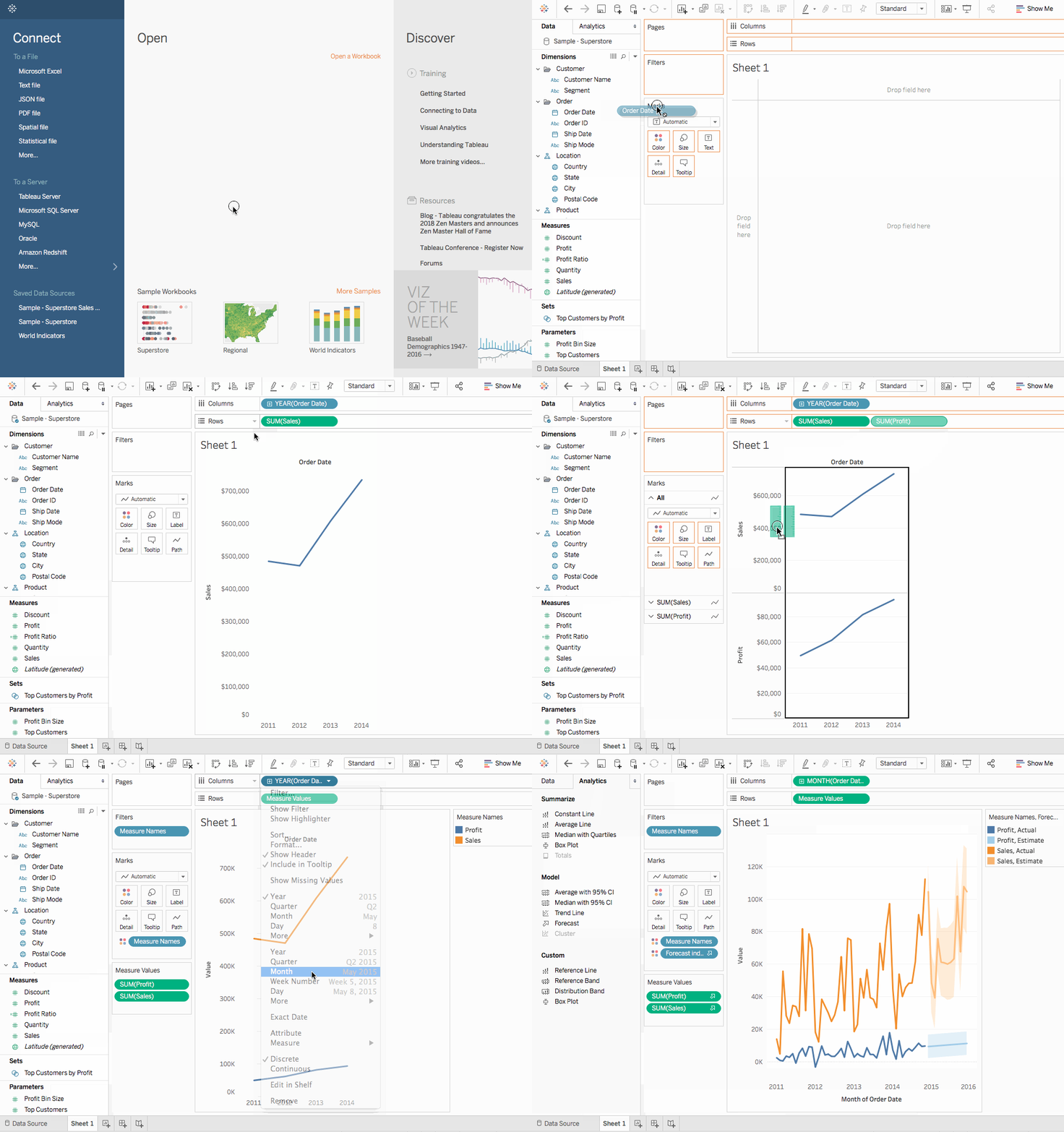
To create a view that displays the sum of sales and the sum of turn a profit for all years, and then uses forecasting to determine a trend, follow these steps:
- Connect to the Sample - Superstore data source.
-
Drag the Social club Engagement dimension to Columns.
Tableau aggregates the date by year, and creates column headers.
-
Drag the Sales measure to Rows.
Tableau aggregates Sales as SUM and displays a simple line chart.
-
Elevate the Turn a profit measure to Rows and drop it to the correct of the Sales measure out.
Tableau creates separate axes along the left margin for Sales and Profit.
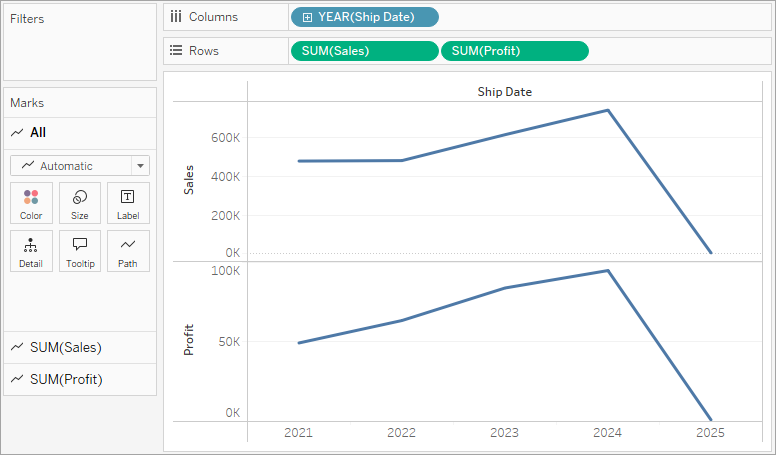
Notice that the scale of the 2 axes is different—the Sales axis scales from $0 to $700,000, whereas the Profit axis scales from $0 to $100,000. This can make it hard to see that sales values are much greater than profit values.
When you lot are displaying multiple measures in a line nautical chart, you tin marshal or merge axes to make information technology easier for users to compare values.
For more data near aligning the axes, encounter Compare ii measures using dual axes.
For more information about enforcing a single axis across multiple measures, see Alloy axes for multiple measures into a single axis.
With either of these options, y'all can create a combination nautical chart to change the marking type for one of your measures.
For more information, run across Create a philharmonic chart (assign different mark types to measures).
-
Drag the SUM(Profit) field from Rows to the Sales axis to create a blended axis. The 2 pale green parallel bars betoken that Turn a profit and Sales will use a blended axis when you release the mouse button.

The view updates to look like this:
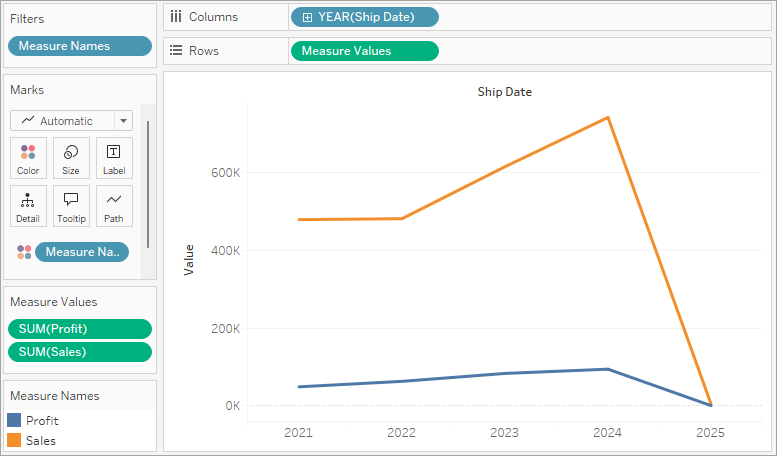
The view is rather sparse because we are looking at a summation of values on a per-year basis.
-
Click the drop-downward arrow in the Yr(Order Appointment) field on the Columns shelf and select Month in the lower role of the context menu to see a continuous range of values over the iv-year period.

The resulting view is a lot more than detailed than the original view:
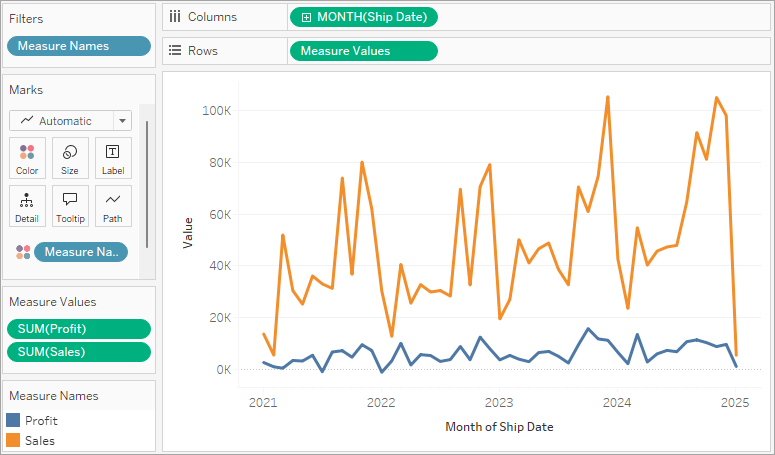
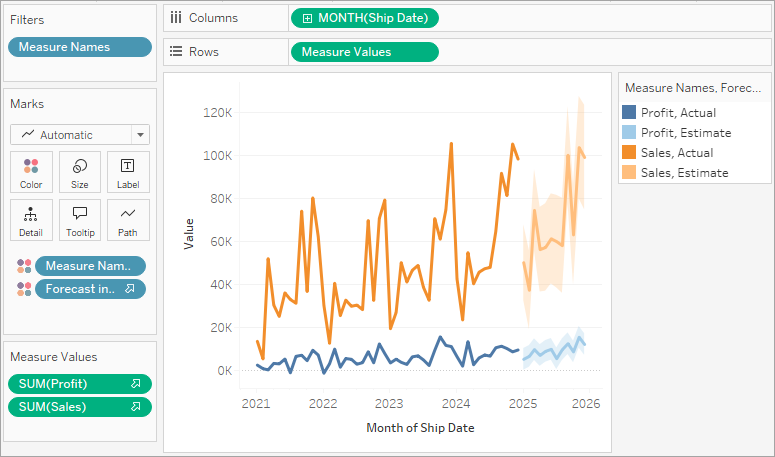
Notice that the values seem to get much college just before the end of each yr. A pattern like that is known as seasonality. If we plow on the forecasting feature in the view, we can run into whether nosotros should wait that the apparent seasonal trend will go along in the future.
-
To add a forecast, in the Analytics pane, elevate the Forecast model to the view, and so drop it on Forecast.
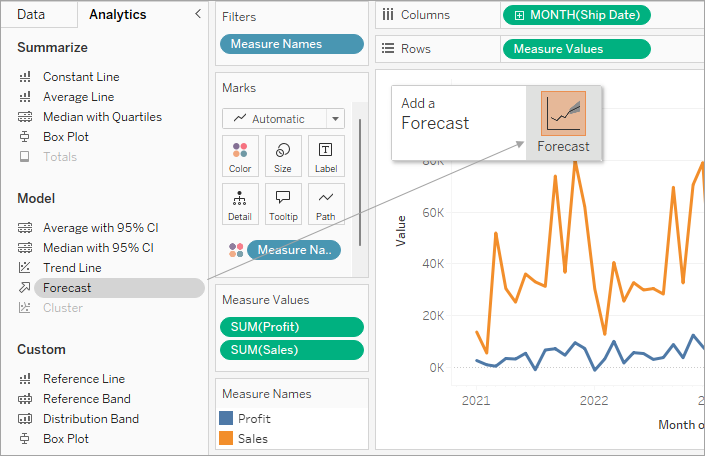
We then come across that, according to Tableau forecasting, the seasonal trend does go on into the future:
Cheque your piece of work! Watch steps 1-7 below:
Note: In Tableau 2020.ii and later, the Data pane no longer shows Dimensions and Measures as labels. Fields are listed by table or folder.

Source: https://help.tableau.com/current/pro/desktop/en-us/buildexamples_line.htm
Posted by: jonesfinerstaide.blogspot.com
0 Response to "How To Draw Two Lines In A Graph Tableau"
Post a Comment